A potato chips line is shorter than a fries line — no blanching-freezing chain — but it is less forgiving in the stages it does have. Slice thickness, oil temperature discipline and de-oiling quality are the three levers behind nearly every chips quality complaint, so this guide concentrates on them.
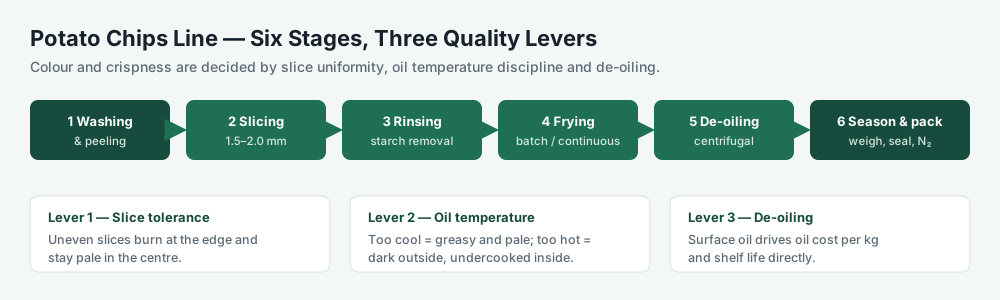
1. The process in six steps
- Washing and peeling: abrasive peeling after a wash; peel loss and potato size range set the pace
- Slicing: slices of even thickness (typically around 1.5–2.0 mm) fry evenly; uneven slices burn on the edges and stay pale in the middle
- Rinsing: a rinse or bubble wash removes surface starch so slices separate and fry crisp
- Frying: batch fryers for small, mixed production; continuous fryers for one product at steady volume
- De-oiling: a centrifugal step spins hot surface oil off the chips — less oil per kilogram, cleaner taste, longer shelf life
- Seasoning and packing: powder dosing or flavour application, then weighing and sealing, ideally with nitrogen flush for retail packs
2. The three quality levers
| Lever | Why it matters | What to check |
|---|---|---|
| Slice thickness tolerance | Uniform slices are the base of uniform colour and crispness | Blade sharpness system, thickness adjustment range, wet vs dry slicing |
| Oil temperature discipline | Too cool makes greasy pale chips; too hot darkens before cooking through | Temperature control accuracy, recovery time after loading, oil turnover |
| De-oiling efficiency | Surface oil drives cost and shelf life directly | De-oiler capacity matched to fryer output, cycle time, residue |
3. Batch or continuous frying
For a start-up producing several snack products in changing recipes, a batch fryer with a round pot or rectangular pan keeps the investment low and flexibility high. A dedicated chips plant running one flagship product daily benefits from a continuous fryer: steadier temperature, less labour per kilogram, more uniform colour. The choice should follow your sales reality, not the sales pitch — many successful plants start batch and convert the frying stage once volume justifies it.
The heating source is a parallel decision: electric, gas or LPG each make sense in different markets, and the reliable-and-affordable option at your site beats the theoretically cheapest one on paper.
4. Oil management is a cost centre, not a detail
Oil is one of the largest variable costs in a chips plant, and it is managed — or wasted — through small habits: filtering frequency, oil turnover rate, avoiding overheating during pauses, and keeping water out of the pan. When comparing fryers, ask how oil is filtered, how much oil the pan holds relative to throughput, and how quickly oil is replaced in normal running. A fryer with better oil management pays back through lower oil consumption per kilogram of chips, which shows up in the accounts long after the purchase price is forgotten.
5. Capacity notes specific to chips
- Chips yield from raw potatoes depends heavily on variety, solids content and peel loss — confirm with a sample fry on your own potatoes before fixing line size
- Seasoning adds weight (powder pickup), which can be part of your net output — state it when comparing quotations
- Packing is often the true bottleneck in semi-automatic plants; count the packing operators when you count staffing cost
- Breakage happens at every transfer point; gentle handling between fryer, de-oiler and packer protects the sellable fraction
6. Seasoning and packing choices
Seasoning ranges from a simple batch tumble with manual dosing to a continuous drum with automatic powder feeding. The right level again follows your product range: many flavours in small batches favour batch equipment; one flagship flavour at volume favours a continuous drum with accurate dosing, because flavour consistency is what retail buyers audit. Packing follows the same logic — a semi-automatic weighing table serves early-stage sales, while vertical form-fill-seal machines with multihead weighers and nitrogen flush are the retail standard. Whatever the level, confirm packing speed with your actual bag material, not with a catalogue figure.
7. Where to see real line configurations
HENAN WEITUO publishes equipment-level pages for the chips process — slicing machines, centrifugal de-oilers and packing machines — which show what a supplier should be specifying at each stage. Their potato chips equipment list guide pairs well with this page when you build your quotation comparison sheet.