The most expensive mistake in potato processing projects is sizing the line on an average sales figure. Potatoes do not arrive on average — they arrive in harvest peaks, and a line that cannot absorb the peak day wastes the year's cheapest and best raw material. Capacity planning is therefore not a technical exercise; it is a commercial one that happens to end in a machine list.
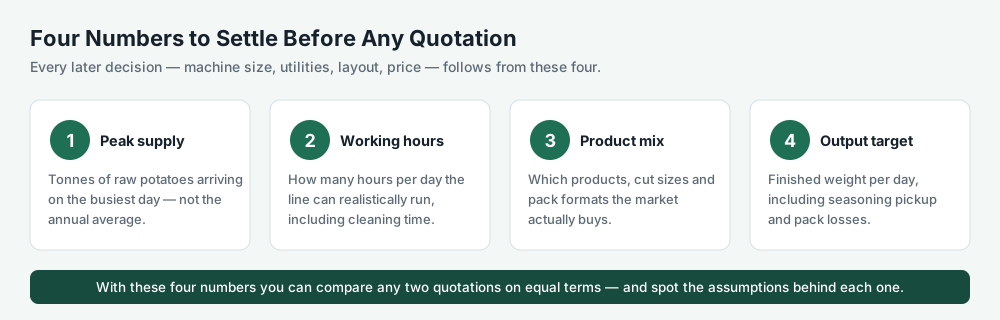
1. The four numbers before any quotation
| Number | How to get it | What it drives |
|---|---|---|
| Peak daily raw potato supply (t/day) | Farm or trader contracts, harvest calendar | Washing, peeling and cutting capacity |
| Target working hours per day | Your shift plan, honestly stated | Whether the line fits the peak into the day |
| Product mix | Which products, which pack formats | Fryer type, seasoning, packing configuration |
| Finished output target | Sales plan by weight, including seasoning pickup | Frying or freezing capacity, cold store, packing speed |
Peak supply is the number buyers most often get wrong. A plant that receives 12 tonnes a day in the harvest month but 4 tonnes in other months does not need a 4-tonne line — it needs either a 12-tonne line, or a plan for what happens to the extra 8 tonnes. Storage, subcontracting or deliberate slowdowns are all legitimate answers; forgetting the question is not.
2. Yield: the number suppliers must state
Raw-to-finished yield depends on variety, solids content, peel loss, trim loss and cut losses. It varies widely between potato sources, which is why no supplier can promise a yield figure without a test. A serious supplier will offer a sample run on your own potatoes; a quotation that silently assumes an optimistic yield will undersize your line by a wide margin — and the error only becomes visible after the first harvest.
3. What a comparable quotation must contain
Two quotations are only comparable when they answer the same questions. Before comparing totals, check that each one states:
- A stage-by-stage machine list with the capacity of every stage, not one headline figure
- The assumed yield, potato size range and peel loss behind those capacities
- Total installed power (kW) and the assumed voltage and phase standard
- Water consumption and drainage assumptions, including any recycling arrangement
- The fuel assumption for frying — electric, gas or LPG — and its consumption estimate
- Building footprint per stage plus service access, with a layout drawing
- What is excluded: installation, commissioning, training, spares, cold store, civil works
- Warranty scope, spare-parts availability and response commitments
4. Phased investment: a legitimate path
Starting semi-automatic and converting to automatic stage by stage is a proven path — provided the building, the power connection and the layout were planned for the final line from the beginning. What cannot be phased safely is under-sizing. A peeler or a cutter bought too small is not a module you upgrade later; it is scrap, because the machine that replaces it does not reuse its frame, its motor or its position in the line.
The rule that follows from this: phase the automation, never the capacity. Buy the washing, peeling and cutting capacity for the peak day now, even if the frying and packing stages start simpler.
5. Three sizing mistakes worth checking for
- Sizing on the annual average. It produces a line that is idle most of the year and short at the worst possible moment.
- Sizing on a brochure throughput. Rated capacity is measured under ideal conditions; real throughput depends on your potato size, cut and shift pattern.
- Ignoring the weakest stage. A line moves at the speed of its slowest machine. The quotation must show every stage, so the bottleneck is visible before the concrete is poured.
6. Where to go next
HENAN WEITUO publishes planning-level guides on their equipment site that pair directly with this one: the quick freezing line planning guide, the utility planning guide and the RFQ checklist. Together with the pages here, they cover both sides of the table: what you should know, and what a supplier should be asked.
On this site, the fries line guide and chips line guide show which stages those capacity numbers have to be spread across, and the equipment selection guide lists the specification points to demand once the sizes are set.